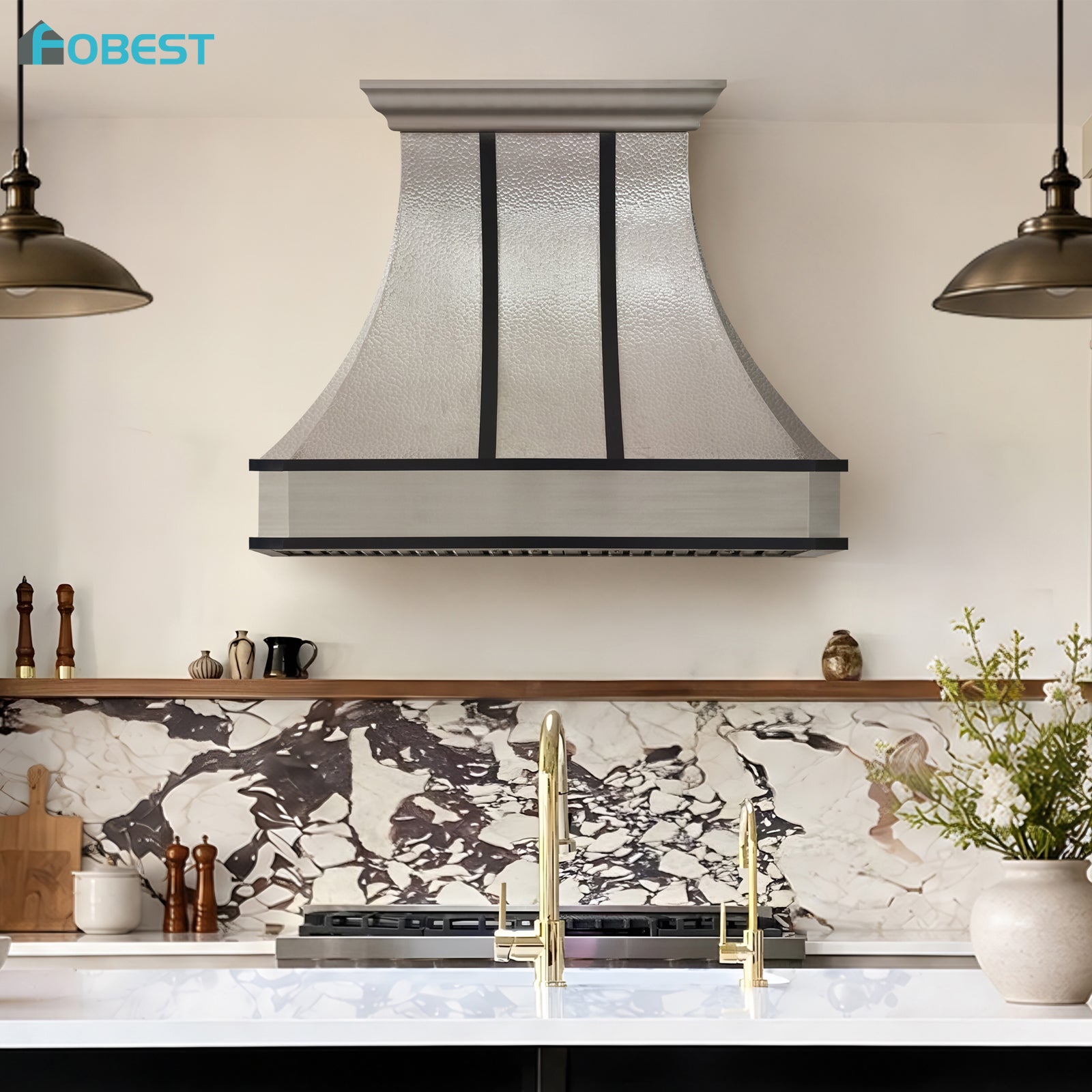

White stainless steel is often thought of as the softer side of metal. But give it the right shape, detailing, and surroundings, and it can become something much more distinctive.
It can feel handcrafted in one kitchen, polished and sophisticated in another, and almost architectural in a third.
That is the appeal of a custom metal range hood.
The material may remain the same, but the design language around it changes everything.
When people picture a stainless steel range hood, they often imagine brushed surfaces, clean lines, and an unmistakably modern or industrial aesthetic.
White stainless steel tells a different story.
 It softens the visual presence of the metal without making it disappear. The curves are still there. The seams, edges, trims, and hardware are still part of the design. What changes is how those details interact with the rest of the kitchen.
And that is where white stainless steel becomes interesting.
The Surface May Be White. The Design Is Still Metal.
A white finish can make a substantial range hood feel quieter against white cabinetry or light stone.
But quiet does not mean ordinary.
On a custom hood, the silhouette can do as much work as the finish. A pronounced curve can create softness. A structured band can add definition. Rivets can reveal craftsmanship. Brass can bring warmth. A carefully proportioned edge can make the entire hood feel more architectural.
In other words, white is only one part of the design.
The personality comes from everything around it.
01 — Crafted: When the Details Tell the Story
The first kitchen feels as though the hood belongs to the architecture rather than the appliance category.
Its white stainless steel body is relatively restrained. The personality comes from what surrounds it: dark metal straps, visible rivets, a generous curved silhouette, and warm farmhouse materials.

Look at the darker metal-Aged brass details and the hood immediately feels more tactile.
The rivets suggest assembly rather than concealment. The straps follow the curve of the body, making the construction itself part of the visual language.
That is what gives this metal range hood its handcrafted character.
It does not need an elaborate finish to make an impression. The interest is already built into the way the hood is made.
This approach works particularly well in a Modern Farmhouse or Transitional Farmhouse kitchen, where natural wood, warm tones, and architectural details create an environment that benefits from a sense of craftsmanship.
Here, white stainless steel does something unexpected:
It makes the craftsmanship easier to see.
Instead of using dark metal as the main visual statement, the white surface becomes the canvas against which every structural detail stands out.
02 — Refined: When Metal Becomes Part of the Palette
The second kitchen takes the same white stainless steel in an entirely different direction.
There is less emphasis on construction and more emphasis on composition.
White cabinetry. Marble. Brass. Glass. Soft lighting.
Nothing is trying to dominate the room.
The range hood becomes one element within a carefully controlled palette, and that restraint is precisely what makes it feel luxurious.
Here, brass does not function as an industrial accent. It behaves more like jewelry.
A thin brass detail can outline a form. A warm metallic tone can interrupt an otherwise pale palette. The white stainless steel provides enough visual calm for those smaller details to have an effect without becoming excessive.

This is where a custom white stainless steel metal range hood can work particularly well in a luxury transitional kitchen.
The goal is not to make the hood look decorative.
The goal is to make it look considered.
Every proportion matters: the width of the hood relative to the range, the depth of the canopy, the curve of the front, and the scale of the brass detailing.
The result is a metal hood that feels less like a separate object and more like part of the interior designer's material palette.
03 — Timeless: When the Hood Becomes Architecture
The third expression is quieter still.
There are no obvious industrial cues. No exposed hardware competing for attention. Instead, the eye is drawn to the silhouette.
A curved hood rises into traditional cabinetry. Crown molding frames the upper edge. Brass introduces a subtle warmth against the white surface.
The effect is almost architectural.
This is where a white metal range hood can challenge the assumption that metal automatically feels contemporary.
It does not.

Metal can be traditional when its proportions, curves, and detailing speak the language of the room.
In a Classic Transitional or French Transitional kitchen, the hood can echo the surrounding millwork rather than contrast with it. Its form becomes an extension of the cabinetry, while the stainless steel underneath gives the piece a different material identity.
The result has a sense of permanence.
Not because it follows a particular trend, but because its design is based on proportion and architectural continuity.
That is an important distinction.
Timeless design is rarely about adding more. It is about making every element belong.
The Possibilities of Custom Metal
This is where customization matters.
A custom metal range hood begins with the kitchen itself—its architecture, proportions, materials, and overall character.
Should the hood blend into the cabinetry or stand out? Would dark metal add definition? Could brass bring warmth? Or would a clean white finish let the architecture speak for itself?
At Fobest, these choices are part of the design process. We combine metal, form, and craftsmanship to create range hoods that feel made for their surroundings.
The material may be the same.
The personality does not have to be.
Explore custom metal range hood design with Fobest.